You’re viewing an abridged version. Open on desktop for the full case study.
How we reimagined Medicare's most painful workflow and built a community of 4,500+ agents

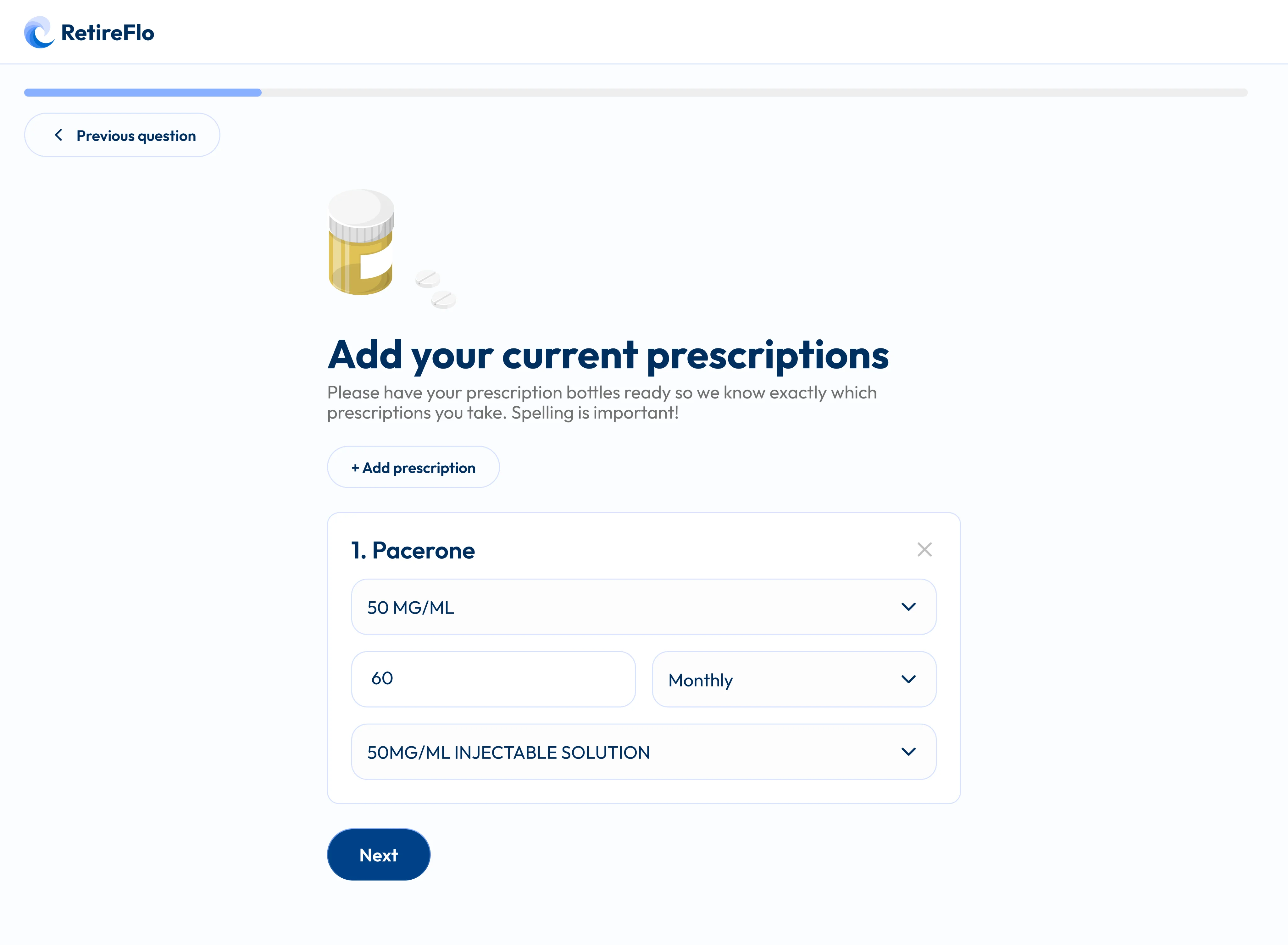
The prescription survey step, where clients add drug names, dosages, and frequencies before their agent meeting.
I joined RetireFlo as founding designer when it was a single survey link. Over two years I redesigned how Medicare agents collect client data, manage compliance, and grow their book of business — turning a manual, error-prone process into an automated workflow platform 7,000 agents built their practices around.
I joined as founding designer and redesigned how Medicare agents collect data, manage compliance, and grow their practice — from a single survey link to a platform 7,000 agents rely on.
$2m ARR
Scaled from $0 to $2M in annual recurring revenue in 2 years
7,000+ users
Medicare advisors nationwide adopted the platform
500k+ submissions
Saving advisors 5+ hours/submission
4,500+ members
Over half our users joined our Facebook community
The worst headache in Medicare
Every October, Medicare agents brace for AEP — 60 days to re-enroll every client before the deadline. It started the same way every time: a phone call. Prescription names, dosages, frequencies, physician names, hospital addresses, spelled out loud while a senior searched their medicine cabinet.
Every AEP, agents spent hours on calls collecting prescriptions and physician details by hand — the same error-prone process, every client, every year.
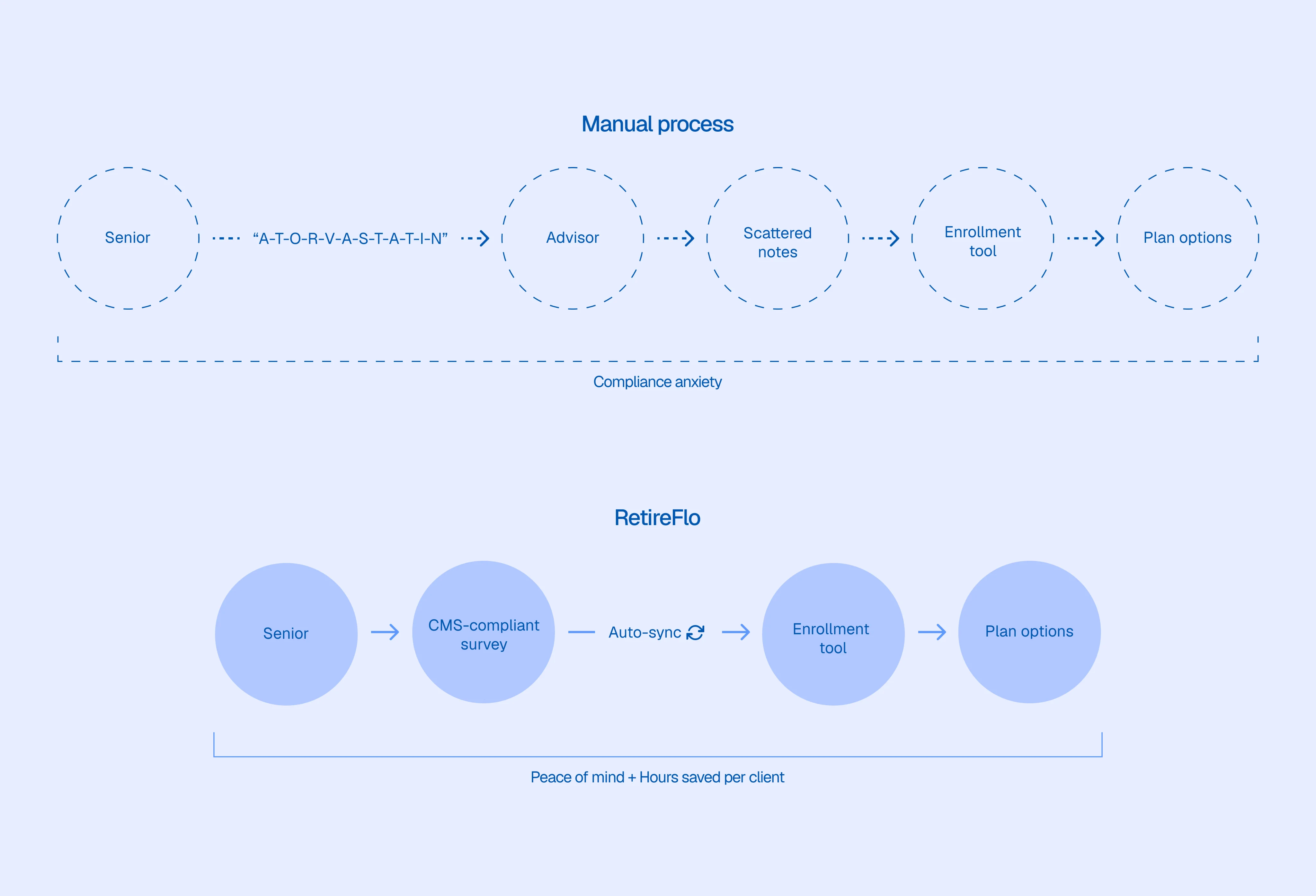
Before and after: the manual phone-call process vs. the RetireFlo automated survey flow.
A single call could take an hour. One wrong letter meant potentially jeopardizing a senior's healthcare. Underneath every call sat a compliance catch-22. CMS required a signed Scope of Appointment form 24 hours before any enrollment conversation, but most agents collected that signature in person, right before the meeting. Without a better solution, they'd need a second meeting just to get a signature, or walk a senior through an e-signature flow over the phone. And when the call ended, none of the data traveled. Agents re-entered everything by hand just to generate plan options. The same hour of work, done twice. Every client. Every year.
Calls took up to an hour, the SOA signature was a compliance catch-22, and none of the data transferred — the same work, done twice, every client.
Flatten the entire pre-enrollment process so agents could walk into their first meeting ready to enroll.
Streamlining Medicare enrollment with CMS-compliant data capture
The client-facing survey, sent ahead of the meeting so seniors fill it out on their own time.
RetireFlo gave every agent a personalized survey link to send clients before the meeting. Clients filled it out on their own time, prescription bottles in hand.
We gave agents a survey link to send before the meeting so clients filled out their prescriptions on their own time.
The core design challenge was data quality. An incomplete or misspelled submission meant the agent had to go back and verify, defeating the purpose. We built the survey step-by-step with deliberate catches: confirmation modals, auto-scroll to flagged inputs, and auto-completion powered by ConnectureDRX's data APIs so that drug names, dosages, and frequencies matched exactly what the enrollment platform expected.
We built the survey step-by-step with confirmation modals and API-powered auto-completion so every submission matched exactly what the enrollment platform expected.
The goal was data that didn't just arrive, it arrived ready to use.
Designing within a federal constraint
Sending the link before the meeting meant clients could sign the Scope of Appointment form digitally, satisfying the 24-hour CMS requirement before the agent ever picked up the phone.
The survey link let clients sign the Scope of Appointment digitally, satisfying the 24-hour CMS requirement before the agent ever called.
The digital Scope of Appointment form, signed by the client before the meeting and satisfying the 24-hour CMS requirement.
The Submission Center, where agents can see signed scope status alongside each submitted survey.
The harder problem was initials. Agents kept reporting that seniors were forgetting to initial specific product categories, meaning the agent couldn't legally discuss those plans even if the client wanted to. CMS rules prevented us from making initials required. So we designed around the constraint: a clear visual state for each product category showing exactly what had and hadn't been initialed before submission. Seniors knew what they were leaving blank, and the nudge worked. Agents re-sending the Scope of Appointment after an incomplete submission dropped by 80%.
CMS prevented us from requiring initials, so we designed a clear visual state for each unsigned category — agents re-sending the SOA dropped 80%.
Closing the data loop
Once submitted, survey data synced automatically to the agent's enrollment platform. We built the integration layer to manage connections, monitor sync status, and surface failures clearly.
Submitted data synced directly to the agent's enrollment platform through an integration layer built to monitor connections and surface failures clearly.
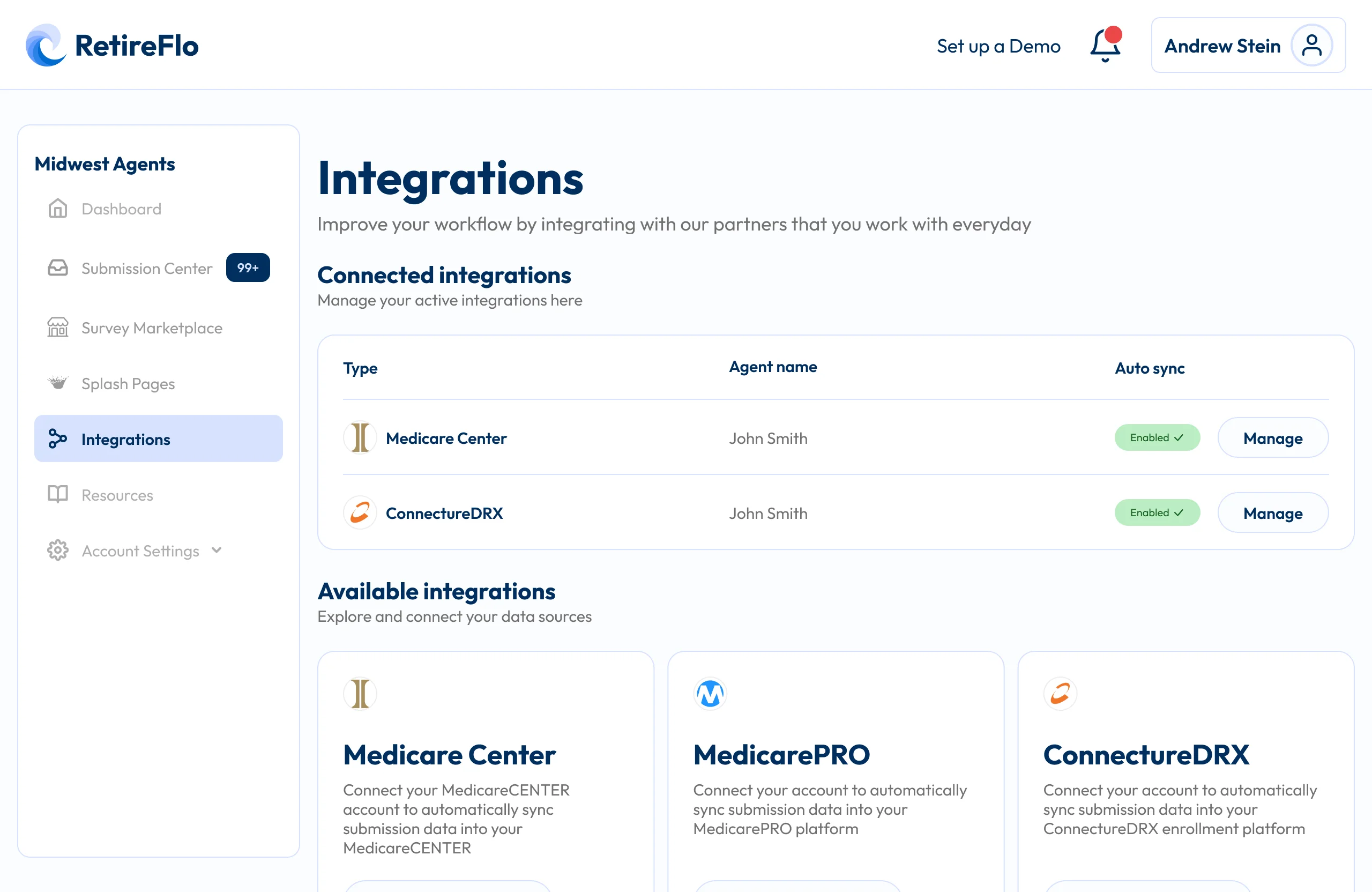
Integration overview. See existing connections or add a new one.
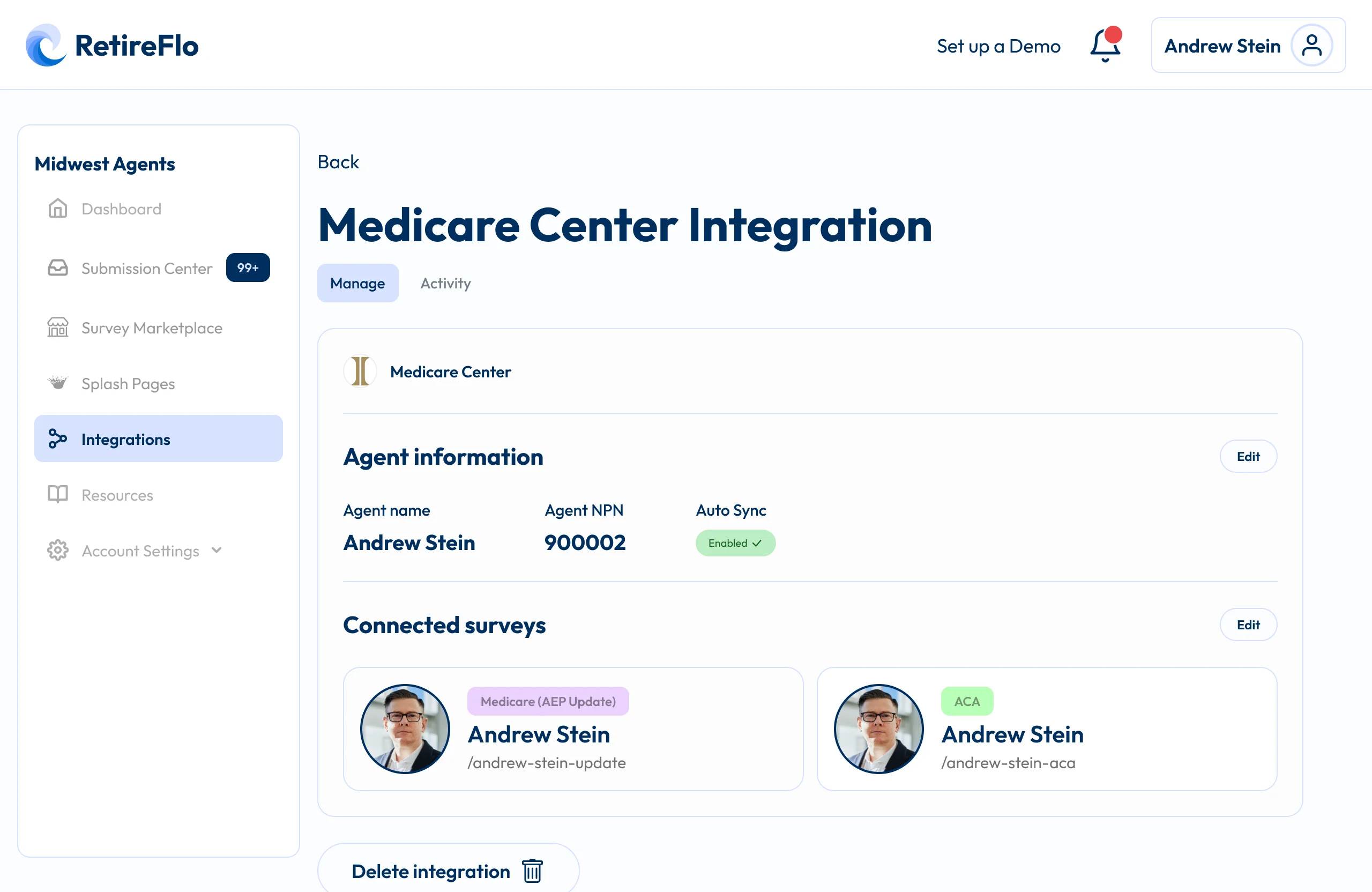
Manage page. Choose which surveys route to which integration, verified by the agent's NPN number.
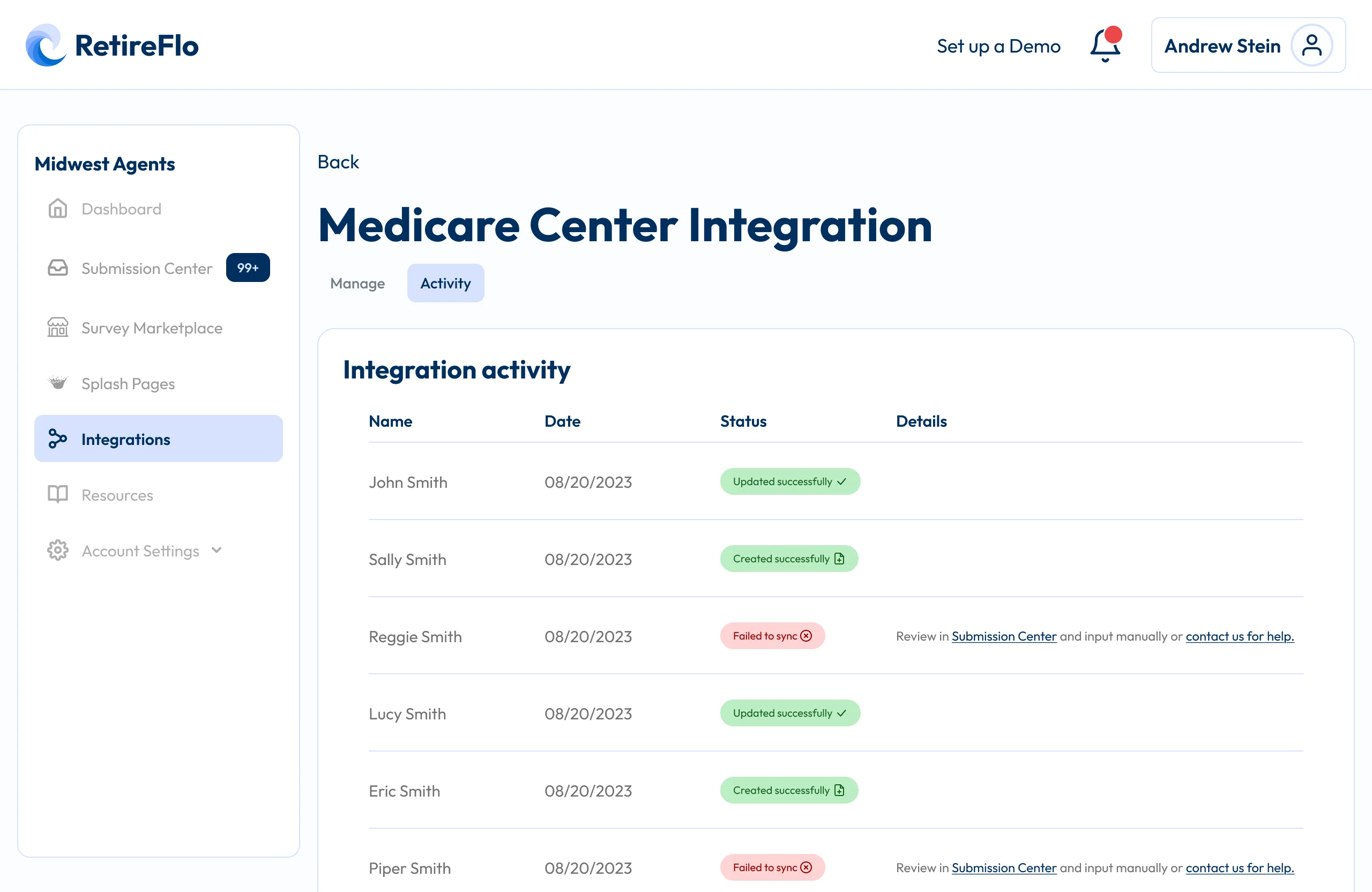
Activity tab. Surfaces sync status and error details agents can relay directly to the support team.
The constraint here was hard: compliance and feasibility meant we couldn't bring enrollment into RetireFlo. So instead of trying to own the workflow, we focused on data provenance, giving agents enough visibility to know the sync was working, and when it wasn't. Enough semantic clarity to describe the error accurately to our customer success team. Medicare agents aren't typically technical. The goal was a 55-year-old agent being able to say “it shows Failed to Sync” and our team knowing exactly what that meant.
We couldn't own enrollment, so we focused on giving agents enough visibility to know the sync was working — with error messages clear enough to relay to support.
Designing for volume
The Submission Center started simple. As agencies scaled to thousands of entries per year, agents needed smarter search, filtering, and sorting to manage their books of business.
As agencies scaled to thousands of entries, the Submission Center grew into a full search and filtering system built around real demand.
Advanced filtering by survey type, prescription, date range, source, and status. Built iteratively as agency volume grew.
We iterated the filtering system repeatedly in response to real demand, adding filters by survey type, prescription, date range, source, and status. By AEP the system could handle the operational weight of a high-volume season. The platform now processes around 200,000 submissions per year.
We added filters in response to real demand until the platform could handle a full AEP season — it now processes around 200,000 submissions per year.
Turning word of mouth into infrastructure
Agents kept telling us the same thing: their best new business came from word of mouth.
Splash Pages, a public agent profile with verified reviews, star ratings, and a referral link clients could share.
We built Splash Pages to give that channel infrastructure: a public profile with verified reviews, star ratings, and referral tools agents could share with prospective clients. For larger agencies, we added a Google Reviews integration that pulled existing reviews directly into their RetireFlo profile. It brought RetireFlo closer to the center of how agencies ran their practices, not just how they processed surveys.
We built Splash Pages — public profiles with verified reviews and referral tools — to give word-of-mouth a repeatable structure agents could build on.
The numbers
57% of users joined Medicare Island, a 4,500-member Facebook group the founder built around the product
These are Medicare agents, average age 50+, who went from spending an hour on a single data collection call to walking into their first client meeting ready to enroll. The platform didn't just save them time. It changed what their job felt like.
Agents went from an hour-long data call to walking into their first meeting ready to enroll — it didn't just save time, it changed what the job felt like.
$2m ARR
Scaled from $0 to $2M in annual recurring revenue in 2 years
7,000+ users
Medicare advisors nationwide adopted the platform
500,000+ submissions
Saving advisors 5+ hours/submission
4,500+ members
Over half our users joined our Facebook community
Takeaways
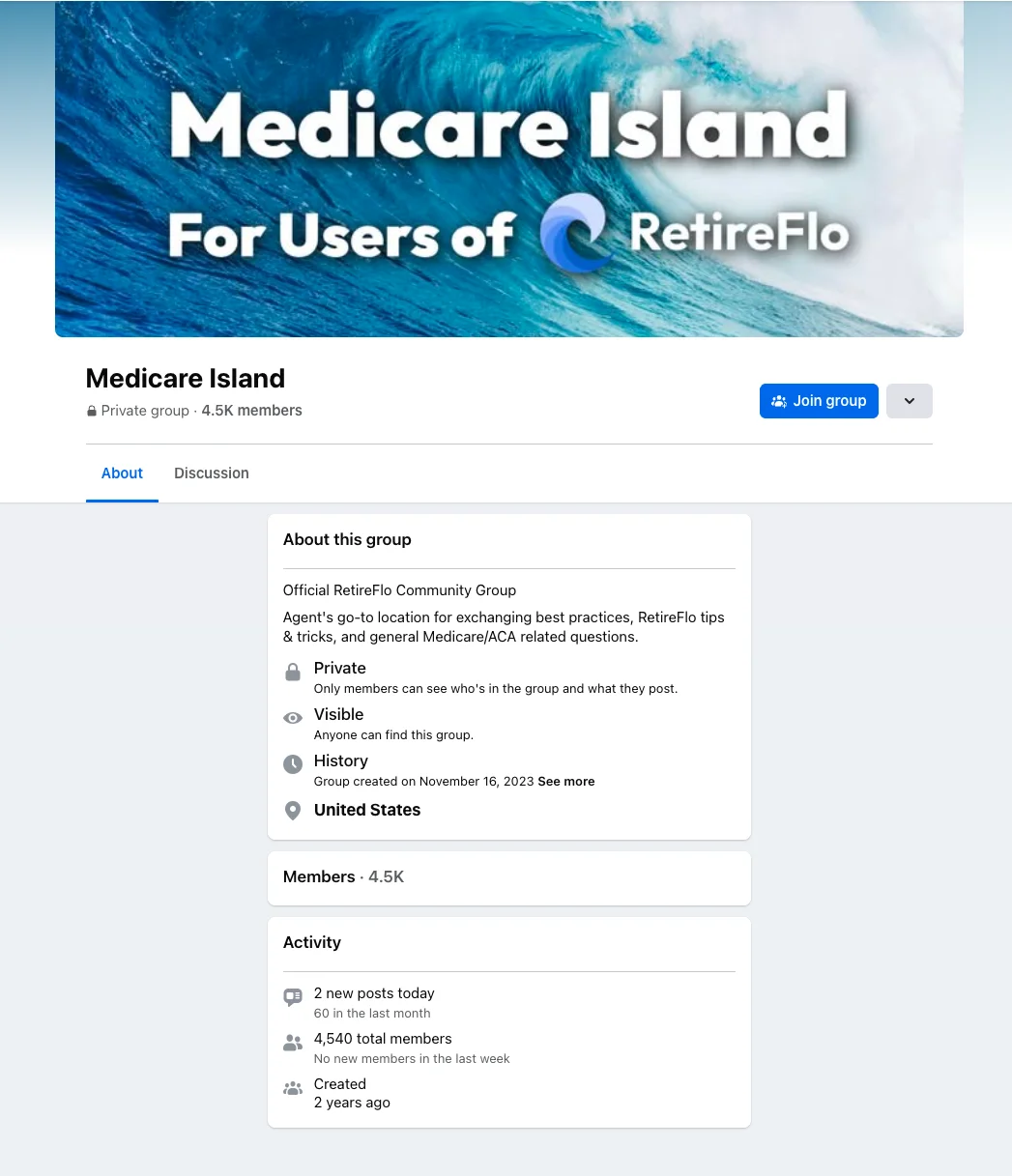
Medicare Island, the private Facebook group the founder built around RetireFlo, now 4,500+ members strong.
Domain fluency is the design work
The hardest part wasn't the UI. It was earning domain fluency in a workflow I'd never touched.
The prescription phone call story was the unlock. Once I could picture a specific agent trying to spell “Atorvastatin” to a client who kept saying “what?” every design decision got clearer.
Once I could picture a specific agent spelling “Atorvastatin” to a confused client, every design decision got clearer.
Dig deeper than face-value feedback
Working with users who have a different technical fluency taught me to dig a layer deeper into their feedback. Medicare agents are experts at their job, not at articulating product problems.
Taking their requests at face value often pointed to the wrong solution. The real work was understanding what they were reacting to, finding the root cause, and solving that instead.
Medicare agents are experts at their job, not at articulating product problems — the real work was understanding what they were reacting to and solving that instead.